
Human editorial review before publication · Member of the Intelligence.Navy Maritime Intelligence Team · 16 Oct 2026 · 16:59 UTC. Incident verification remains separate.
Research context & editorial review- Original source published
- 16 Oct 2026 · 03:43 UTC
- Source updated
- 16 Oct 2026 · 03:43 UTC
- Analysis reviewed
- 16 Oct 2026 · 04:04 UTC
- Human review
- 16 Oct 2026 · 16:59 UTC
- Added to portal
- 16 Oct 2026 · 03:57 UTC
- Source check
- 16 Oct 2026 · 18:58 UTC
External source reporting used in this assessment
The Maritime Executive · Unmanned Vessel Deploys With Carrier Strike Group for the First Time
Key judgment
The reported deployment is a meaningful integration milestone, but its maritime value now depends on sustained command and logistics performance, not the presence of an extra hull alone. A dated Navy fueling record adds a concrete support activity; it does not establish unattended replenishment or extra combat firepower. [official, fuel]
Cao's deployment statement is recorded in an official 15 October account of the 14 October AUSA panel; the stated deployment date is 8 October.
The 11 September fueling caption adds a vessel-specific sustainment event, but contains no measurements establishing unattended or repeatable replenishment.
The procurement release differentiates production awardees from Leidos's prototype completion and follow-on eligibility.
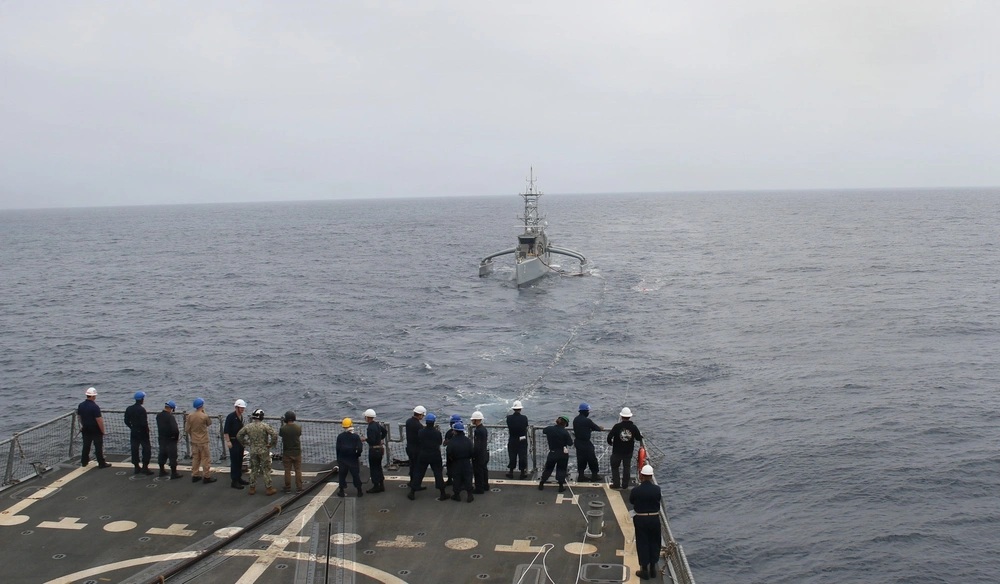 SOURCE PHOTOGRAPH
USV
Intelligence question & baseline
What does Seahawk's reported carrier deployment establish beyond experimental participation, and what should fleet and procurement planners count as usable maritime capability?
At portal collection on 16 October 2026 the retained source was a deployment abstract with no assessment. Leidos had used operational language on 8 September; TWZ still reported Seahawk pierside on 30 September. Cao's 14 October remarks name 8 October, while TWZ dates the carrier's departure to 27 September. These may describe different phases, not one reconciled departure time. [lead, supplier, chronology, official]
Finding beyond the lead source
The specific Chafee fueling record demonstrates a support evolution for the same vessel, while the separate production announcement differentiates prototype participation from procurement allocation. The next capability threshold is repeatable supported operation, not merely a deployment label. [fuel, procurement][4][5]
Decision affected & alternative explanation
Naval force planners and maritime-autonomy procurement teams · Count demonstrated support activities separately from sustained mission capacity; qualify a supplier's contract position from the relevant award, not its prototype's visibility. [fuel, procurement]
Alternative explanation · This may remain a closely supported operational-learning deployment rather than an independently sustainable additional mission unit. Earlier supplier and later official uses of deployment may refer to training, joining or distinct phases. [supplier, chronology, official]
Revise the judgment when · A dated deployment evaluation identifying task completion, useful availability, interventions, refueling conditions and lost-link recovery, together with accepted deliveries or an explicit follow-on award, would support a stronger judgment. [fuel, procurement, supplier]
What we learned
The lead's deployment claim becomes more useful when matched to two separate case records: an actual support evolution and a procurement decision. These show why deployed-prototype experience, supportability and a production award are different milestones. Leidos's earlier operational language also predates the October statement; it cannot by itself settle the departure chronology. [fuel, procurement, supplier, chronology]
Maritime implication
Fleet planners should assess sustained useful availability and support burden before counting the USV as additional mission capacity. Procurement teams should request deployment-specific acceptance and delivery evidence, rather than treating an incumbent prototype's participation as proof of a production win. [fuel, procurement, official]
Deployment is a phase change, not a single headline date
Reported · The official October statement is later than supplier integration claims and the 30 September report that the USV remained in port. The carrier's reported 27 September sailing and Cao's 8 October reference are retained separately; the retrieved documents do not reconcile joining and departure dates.[2][6][3]
Analytical inference · This makes the present update evidence of an announced operational phase, not a discovery that unmanned systems had never previously operated with crewed forces.[2][3][6]
Useful availability depends on the support chain
Reported · The Navy's dated caption anchors a real fueling activity involving Seahawk and a destroyer. It demonstrates preparation for support at sea without specifying throughput, environmental limits or whether the receiving operation was unattended.[4]
Analytical inference · For a force planner, adding a hull is only useful if its supported task output exceeds the coordination and support it consumes. Request comparable mission and intervention records before increasing assumed surveillance capacity or reducing crewed support.[4][2]
Operational visibility is not production allocation
Reported · The September procurement release places three companies in production agreements and Leidos in the separate prototype-completion and future-eligibility group.[5]
Analytical inference · For maritime integrators, qualification should therefore distinguish platform integration experience from awarded production and accepted deliveries. A successful prototype may inform fleet practice without establishing its builder as the production supplier.[5][3]
Business conclusions for maritime intelligence
Analytical inference · Buyers should evaluate integration experience, sustainment evidence and production entitlement separately; a carrier-associated prototype does not itself establish scalable deliveries or a particular supplier's follow-on contract.[5][4][3]
Confidence & evidence limits
MODERATE · Official and supplier records support participation and a specific logistics activity. They share the Navy programme environment, not independent combat observation. No mission-performance report establishes payload effect, availability, support cost or operation under adversarial interference. [official, supplier, fuel]
Evidence & analytical reasoning
Reported · Cao's deployment statement is recorded in an official 15 October account of the 14 October AUSA panel; the stated deployment date is 8 October.[2]
Reported · The 11 September fueling caption adds a vessel-specific sustainment event, but contains no measurements establishing unattended or repeatable replenishment.[4]
Analytical inference · Supplier integration claims and September reporting do not establish one unambiguous start date for the present operational phase.[3][6][2]
Reported · The procurement release differentiates production awardees from Leidos's prototype completion and follow-on eligibility.[5]
Analytical inference · Integration and logistics evidence justify evaluating a supported deployment, not assuming proven independent mission capacity or incremental combat effect.[2][4][3]
Next decision indicators
- Deployment report separating autonomous transit, supervised operations, interventions and mission-task completion. [official, supplier]
- Repeated Seahawk replenishment records with sea conditions, human support and time unavailable. [fuel]
- Acceptance tests or delivered-vessel notices and any specifically named Leidos follow-on production award. [procurement]
Publication history · 3 captured versions
Loading captured versions…
Evidence & references
- [1] Unmanned Vessel Deploys With Carrier Strike Group for the First TimeSource account
- [2] Hegseth: Autonomous Warfare Command has always been end stateCandidate linkage · unconfirmed
- [3] Leidos autonomy earns its place at RIMPAC and with carrier strike groupCandidate linkage · unconfirmed
- [4] USS Chafee conducts fueling evolution with USV SeahawkCandidate linkage · unconfirmed
- [5] Navy to Procure 30 Medium Unmanned Surface Vessels Following Completion of Phase I At-Sea TestingContext reference
- [6] Where Are The Aircraft Carriers?: September 30, 2026Context reference
Evidence scope & unresolved questions
- Exact joining date, payload, tasking and deployment-specific mission outcome are not established by the retrieved record. [official, chronology]
- No measured availability, maintenance interval, communications failure rate or replenishment envelope was obtained. [fuel, supplier]
- An account of GPS-denied waypoint operation supplies no evidence of resilience against every form of jamming or spoofing. [supplier]
- No retrieved evidence connects Seahawk with Cao's separate Corsair rescue or mine-clearance remarks; those are not this vessel's results. [official]
- Public military accounts and supplier claims are not independent operational witnesses; no direct human reporting was collected.
AI-assisted research, followed by recorded human editorial approval. Approval is not independent verification of the incident.. AI-assisted synthesis with recorded human editorial review; event verification remains limited by the attached sources.
Unmanned Vessel Deploys With Carrier Strike Group for the First Time: Retained portal source record. Portal abstract consulted. Direct web retrieval of the original body failed; articleBodyAvailable is not treated as evidence of reading its full text.
Hegseth: Autonomous Warfare Command has always been end state: Army-hosted Pentagon News; no deployment log, payload inventory or operational evaluation attached.
Leidos autonomy earns its place at RIMPAC and with carrier strike group: Supplier account, not an independent benchmark; no duration or error distribution for the GPS-denied claim.
USS Chafee conducts fueling evolution with USV Seahawk: Caption and metadata, not a measured replenishment or availability report; no raw-image analysis or image change proposed. Caption and uploader credits differ.
Navy to Procure 30 Medium Unmanned Surface Vessels Following Completion of Phase I At-Sea Testing: Issuer procurement account; underlying agreements, accepted deliveries and case-specific payloads not retrieved. Not independent operational corroboration.
Where Are The Aircraft Carriers?: September 30, 2026: Historical reporting, not a current vessel location. Its AIS/video inputs were not independently reacquired; an AIS gap establishes no intent.