
Intelligence.Navy Incident Assessment · HIGH in sinking and crew outcome (MPA), and in the attributed official hazardous-cargo warning (Times of Oman). Original MTCIT notice pending. Cargo identity, containment, release and coastal exposure are unresolved.
- Event
- 13 Oct 2026 · time not supplied
- Published
- 14 Oct 2026 · time not supplied
- Assessment updated
- 16 Oct 2026 · 19:00 UTC
- Analysis reviewed
- 16 Oct 2026 · 19:00 UTC
- Added to portal
- 14 Oct 2026 · 22:18 UTC
- Visual update · presentation only
- 15 Oct 2026 · 12:09 UTC
- Source check
- 16 Oct 2026 · 19:00 UTC
Key judgment
The hazardous-cargo confirmation raises the consequence profile of GFS PRIDE: response now requires cargo identification, containment checks, recovery prioritisation and environmental monitoring alongside navigation and salvage. Hazardous cargo present does not establish a hazardous release. HIGH confidence concerns the documented casualty and attributed warning; specific substances and exposure remain unresolved.
Oman’s confirmation that some containers drifting from GFS PRIDE contain hazardous materials materially changes the incident assessment. The casualty can no longer be treated primarily as a wreck, debris-field and feeder-network disruption. The confirmation is attributed to MTCIT by Times of Oman; the original ministry warning remains pending recovery.
The operating picture now combines an identified wreck, floating containers, dangerous cargo, uncertain packaging integrity, potential exposure of fishermen and local maritime users, navigation hazards and salvage requirements. Chemical exposure, environmental contamination and coastal impacts are possible consequence pathways, not established outcomes.
No release of hazardous substances into the sea has been confirmed in the evidence reviewed. The critical questions are which containers carry dangerous goods, whether containment has failed, where floating cargo is moving and whether shipping routes, fisheries, sensitive marine areas or coastal communities could be exposed. No incident-specific drift model has been run.
HAZARDOUS CARGO CONFIRMED does not equal HAZARDOUS RELEASE CONFIRMED. The 14–15 October record remains available in version history; this edition adds the 16 October warning without rewriting earlier knowledge.
GEOSPATIAL INCIDENT PICTURE
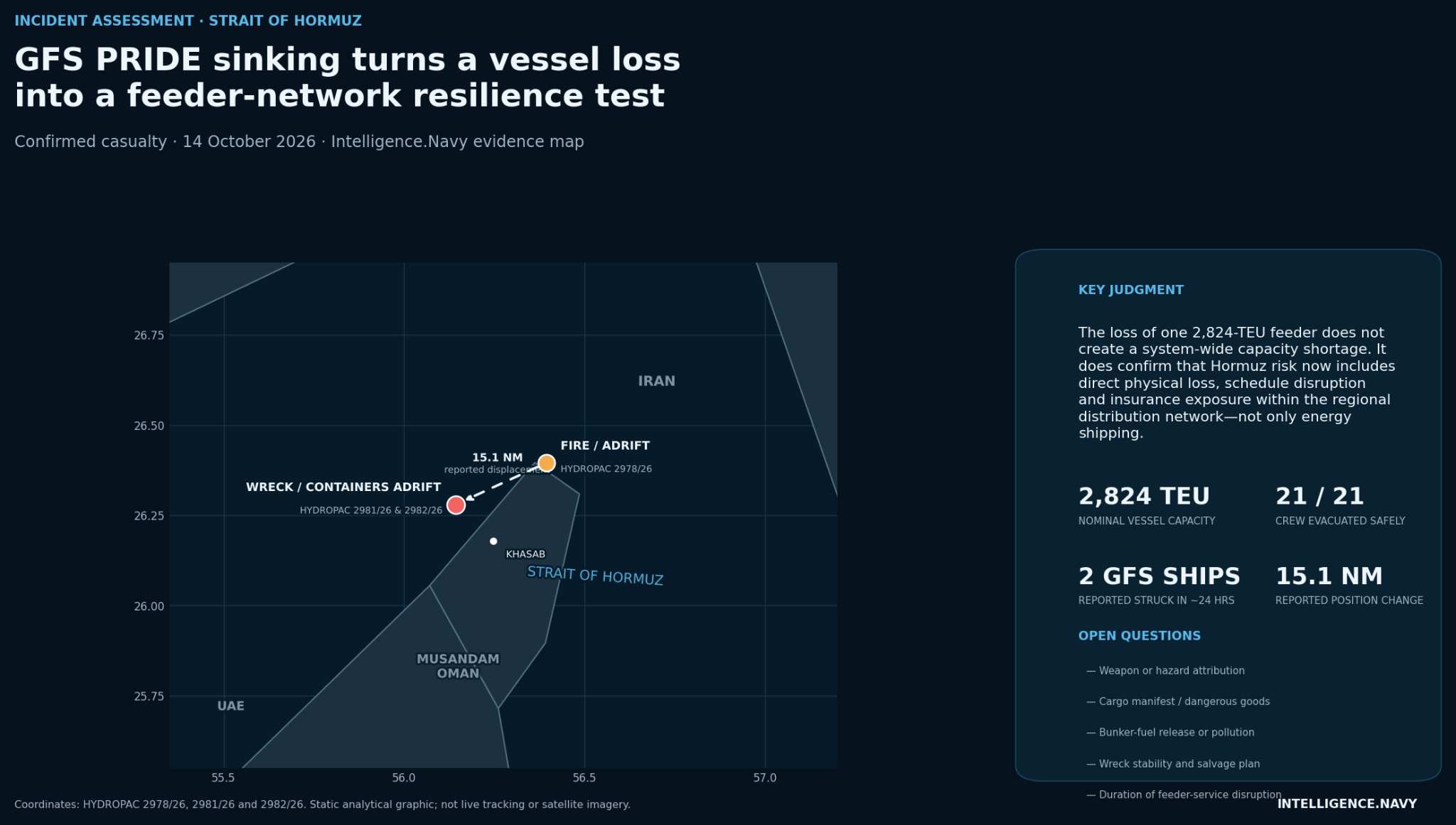 STATIC EVIDENCE MAP
Editorial geospatial reconstruction based on reported navigation-warning positions. The connecting line represents the approximate displacement between two reported positions, not a continuously observed vessel track.
FIRE / ADRIFT · 26°23.70′ N, 56°23.60′ E
WRECK / CONTAINERS ADRIFT · 26°16.80′ N, 56°08.60′ E
Editorial geospatial reconstruction based on reported navigation-warning positions. The connecting line represents the approximate displacement between two reported positions, not a continuously observed vessel track.
Approx. 15.1 NM separation between reported positions. This is not a continuous AIS track, a measured debris footprint or evidence of the cause of sinking.
Key judgments
01 · HIGH CONFIDENCE — Hazardous materials materially raise the consequence profile. GFS PRIDE now requires dangerous-goods intelligence, recovery prioritisation and environmental monitoring as well as conventional wreck and debris management.
02 · HIGH CONFIDENCE — Loss of containment is a critical escalation threshold. An intact outer container does not prove that its internal packages remain intact. Damage, immersion, fire and leakage require specialist assessment; the relative risk cannot be ranked reliably without cargo and condition data.
03 · HIGH CONFIDENCE — The cargo manifest is the priority unresolved intelligence requirement. IMDG classification, UN numbers, quantities, packaging and stowage position would materially improve human-health, environmental and recovery prioritisation.
04 · HIGH CONFIDENCE — Satellite observation can support search and response but cannot independently identify the chemical contents of a closed container. Cargo identification depends on records, physical inspection and specialist teams.
05 · HIGH CONFIDENCE — Security, navigation, dangerous goods, salvage and environmental information must be integrated. The casualty illustrates a pathway from a shipping attack to a coastal-response emergency; a chemical spill or coastal impact has not been demonstrated.
What changed · 16 October 2026
Times of Oman reports that MTCIT warned fishermen and seafarers near Ras Al Sheikh Masoud in Musandam after the sinking of GFS PRIDE on 14 October. The warning identifies floating containers, including some carrying hazardous materials, instructs maritime users to avoid handling or approaching them and requests immediate reporting of sightings.[9]
The report describes coordinated maritime monitoring and recovery activity involving competent authorities. This is a material addition to the retained evidence record. It is an attributed ministerial confirmation; the original MTCIT notice has not been recovered and independent cargo verification is unavailable.[9]
Casualty baseline · historical record
MPA’s 14 October statement reports that GFS PRIDE was struck by an unknown projectile while transiting Hormuz on 13 October, Singapore time, sustained damage and fire, and subsequently sank. All 21 crew members were safely evacuated; no injuries were reported. MPA’s separate GFS GISELLE account is not a second GFS PRIDE casualty.[1][3][4][7]
The initial fire/adrift position and subsequent wreck/container-warning position are retained unchanged. Navigation warnings establish reported hazards, not a surveyed wreck footprint, continuous vessel track, present debris boundary or clearance. The original dated IMO no-pollution entry remains historical evidence, not a current environmental survey.[1][3][4][7]
Why this changes the assessment
Before the Omani warning, the retained consequences centred on loss of the vessel, a wreck in a strategic waterway, floating containers, potential bunker pollution, salvage and feeder-connectivity exposure. Hazardous cargo adds a separate consequence pathway whose scale cannot yet be quantified.
Container losses are not a uniform risk. Consequence depends on contents, IMDG class, internal package condition, flotation or submergence, seawater contact, fire and impact damage, shore proximity and recovery feasibility. Corrosive, toxic, flammable, oxidising and environmentally hazardous cargo require different response decisions. None of those specific cargo classes has been established for the lost containers.
Dangerous-goods intelligence requirement
The priority collection package is: container identification numbers; IMDG classes; UN numbers; proper shipping names; packing groups where applicable; quantities; packaging types; dangerous-goods declarations; stowage positions before loss; reefer/dry/tank-container status; last-observed condition; and any fire or impact damage before immersion.[10]
Article 185 of Oman’s Maritime Law provides a documentary framework for written cargo particulars, notification of hazardous, flammable or explosive goods, warning statements and IMDG compliance. Such requirements support seeking the records. They do not prove that accurate declarations exist for every lost container, that responders hold them, or that every carriage falls under the same legal jurisdiction.[10]
Cargo documentation, operator records and inspection should be cross-checked. HAZARDOUS CARGO CONFIRMED is distinct from HAZARDOUS RELEASE CONFIRMED.[10]
Environmental assessment
No verified hazardous-cargo discharge, significant bunker-fuel release or environmental contamination has been confirmed in the evidence reviewed. Absence of a verified report does not establish that all containers and packages remain intact.
CONTAINER FAILURE — Outer-container condition and internal packaging are separate barriers. A floating, flooded, submerged or mechanically damaged container needs cargo-specific evaluation; visual appearance alone cannot establish chemical containment.
BUNKER FUEL — Residual marine fuel and lubricants are a separate potential pathway at the wreck. Quantities, tank condition and any subsequent release remain unresolved.
HAZARDOUS CARGO — If packaging fails, effects depend on the substance: localised or dispersed, soluble or floating, volatile or persistent, with different toxicity and response implications. A surface slick is neither necessary nor sufficient to identify every dangerous substance.
PHYSICAL DEBRIS — Ordinary containers and cargo can also obstruct navigation or damage fishing grounds, habitats and shorelines. Such harm has not been measured for this casualty.
SHORELINE EXPOSURE — Wind, currents, waves, container immersion and buoyancy may move cargo toward or away from coastal receptors. Drift modelling would prioritise search and monitoring; no measured trajectory, impact forecast or exclusion boundary is published in this assessment.
Maritime operating picture
NAVIGATION — Floating and partly submerged containers may be difficult to detect at night or in poor visibility. The response picture must distinguish reported positions, sightings, recoveries and verified clearance.[1]
SECURITY — MPA documents attacks on GFS PRIDE and GFS GISELLE in Hormuz. The identity of the attacker and target-selection logic remain unresolved for this casualty. Security exposure may constrain survey access and recovery; it does not establish a regional closure.[1]
RESPONSE — Salvage access, vessel availability, response routes, crew protection, insurance and the ability to remain on scene require dated operational evidence. A recovery plan must account for the elevated security setting as well as cargo-specific hazards.[1]
Geostrategic significance
The casualty illustrates how secondary consequences may outlast the initiating attack. Wreck surveys, container recovery, dangerous-goods management, environmental monitoring, navigation warnings, insurance and salvage may create burdens over days or weeks; that is an analytical outlook, not a verified recovery timetable.
The strategic effect therefore includes potential costs to coastal authorities and route confidence as well as loss of a hull. One feeder loss does not establish a regional capacity shortage or breakdown of Gulf container connectivity. Measurable service changes still require operator and port evidence.
Musandam exposure
The warning identifies maritime users near Ras Al Sheikh Masoud. Coastal settlements, fisheries, shipping approaches and marine habitats are relevant potential receptors. No casualty-specific exposure radius or assessment of local salvage capacity has been verified.[9]
If containers or released cargo approach the coast, priorities would include local warnings, shoreline monitoring, cargo-specific recovery and specialist public-safety measures. Fishing restrictions or evacuation should be reported only when issued by competent authorities; neither is asserted here.[9]
Response capability
The MTCIT warning, as reported, describes coordination for monitoring and recovery. It does not identify a salvor, confirm recoveries or quantify operational capacity.[9][11]
Separately, Times of Oman reports that the Ministry of Health inaugurated a mobile hazardous-material decontamination unit at Khasab Hospital on 15 October, within a programme intended to deploy eleven units nationally. This is contextual preparedness. No evidence establishes that the unit was created, deployed or used because of GFS PRIDE. A healthcare decontamination capability does not establish chemical containment or marine recovery capacity.[9][11]
Satellite and remote-sensing role
SAR may detect larger floating targets under suitable sensor, geometry and sea-state conditions, observe response-vessel activity and identify some surface anomalies through darkness and cloud. Container detection is not guaranteed, and an anomaly is not independently identified pollution.[8]
Optical and high-resolution optical imagery may classify visible debris, document exposed wreck features and salvage activity, and support search planning under favourable illumination, cloud and sea conditions. They cannot inspect submerged wreck structures or infer contents of a closed container.[8]
AIS can support identification of transmitting response vessels and traffic interaction, but does not track drifting containers or prove compliance with an exclusion area. Drift models can prioritise search areas only when observations, forcing data and uncertainty are made explicit.[8]
The response workflow is manifest intelligence + satellite observation + oceanographic modelling + field confirmation + salvage/hazmat response. Chemical identity and release status require appropriate field evidence and specialist interpretation.[8]
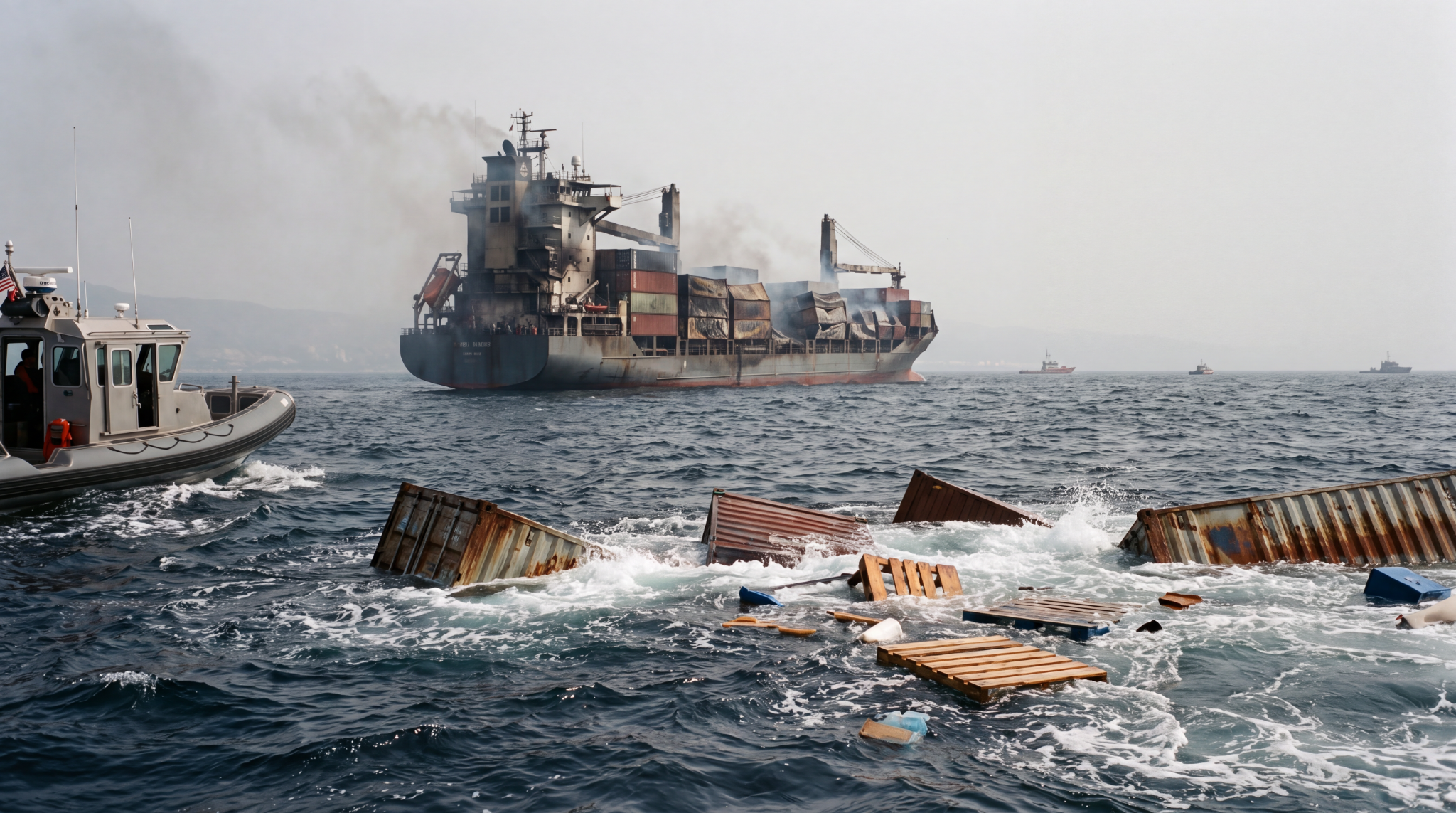
The retained Copernicus/Reuters image-caption correction remains material: the distributed image has not been defensibly linked to GFS PRIDE. Neither that image description nor the AI editorial hero substantiates cargo identity, container counts or pollution. The geospatial map remains a reconstruction of reported warning positions.[8]
Salvage and recovery implications
1 · NAVIGATIONAL HAZARD REMOVAL — Locate and recover large containers and debris affecting shipping routes, using current warnings and verified sightings.
2 · DANGEROUS-GOODS PRIORITISATION — Identify hazardous containers and prioritise recovery where cargo-specific risk warrants. An unsafe lift could increase exposure; prioritisation requires specialist advice and containment information.
3 · WRECK STABILISATION AND POLLUTION PREVENTION — Survey structure, residual cargo, machinery spaces and bunker tanks. Wreck stability, water depth, tank condition and feasible intervention remain collection requirements.
Submerged containers are a distinct search and recovery problem. Their number, positions and hazards have not been established. Specialist sonar or other field surveys may be required; satellite imagery alone cannot resolve the underwater picture.
Indicators & warnings
DANGEROUS GOODS · Manifest or declarations; container IDs; IMDG classes; UN numbers; quantities and packaging; expanded authority warnings; specialist hazmat deployment.
ENVIRONMENT · Verified sampling, identified substances, surface anomalies, discoloured water, wildlife impacts, odour reports and shoreline observations. Treat unverified sightings as leads, not chemical confirmation.
DEBRIS · Dated sightings, recoveries, beaching and submerged-container warnings; reconcile counts and position uncertainty.
SALVAGE · Named contractors, specialist vessel arrivals, wreck surveys, diving, lifting and bunker-removal activity; distinguish mobilisation from completed work.
NAVIGATION · New, revised or cancelled NAVAREA/HYDROPAC warnings, routing and speed measures, exclusions or local closures issued by authorities.
PUBLIC HEALTH · Confirmed exposures, medical warnings or actual use of decontamination capability; do not infer exposure from capability availability.
CONNECTIVITY & SECURITY · Operator schedules, port restrictions, insurance terms and further attacks; measure effects separately from the casualty count.
Intelligence gaps
01 · Full cargo manifest and dangerous-goods declarations.
02 · Number and identification of lost containers.
03 · Number of hazardous-goods containers.
04 · IMDG classifications and UN numbers.
05 · Exact substances, quantities and packing groups.
06 · Internal packaging integrity and outer-container condition.
07 · Number recovered, with dated recovery confirmations.
08 · Number and current positions still floating.
09 · Number and positions believed submerged.
10 · Whether any dangerous substance has entered the sea.
11 · Whether bunker fuel has escaped; remaining fuel quantities.
12 · Exact wreck condition, orientation and stability.
13 · Water depth at the wreck.
14 · Authority and operator responsibilities for recovery.
15 · Appointed salvage contractor and response assets.
16 · Expected recovery duration and access constraints.
17 · Environmental sampling methods and results.
18 · Coastal exposure forecast based on a documented drift model.
19 · Original MTCIT warning and attributable direct responder/HUMINT reporting.
20 · Attribution, damage mechanism and weapon; original satellite scene and verified casualty linkage.
Alternative scenarios
SCENARIO 1 · CONTROLLED RECOVERY — Hazardous packages remain intact and priority containers are recovered before coastal exposure. Environmental consequences remain limited. Confirmation requires inspection, recovery reporting and appropriate sampling.
SCENARIO 2 · DISPERSED DEBRIS FIELD — Containers spread over a wider area, extending searches, navigation warnings and recovery complexity. This requires dated geolocated sightings or model results validated against observations.
SCENARIO 3 · HAZARDOUS RELEASE — One or more dangerous-goods packages lose containment. Response expands to substance-specific environmental and hazmat measures alongside salvage. No such release has been confirmed.
SCENARIO 4 · COASTAL IMPACT — Containers or released cargo reach Musandam’s coast, expanding shoreline, fisheries and public-safety requirements. No coastal impact has been established.
These are conditional, potentially overlapping pathways. Current evidence does not establish which will dominate; no numerical probabilities are assigned.
Outlook
The next decisive intelligence development is the identification and condition of the dangerous cargo. The manifest, recovery reports, field inspection and environmental sampling will determine whether the event remains primarily a salvage and navigation problem or develops into a wider hazardous-material emergency.
Until those questions are resolved, GFS PRIDE should be treated as an active multi-hazard maritime incident. DETERIORATING / ACTIVE RESPONSE describes the expanded consequence profile and reported response coordination. It does not establish measured worsening pollution, an accelerating debris field or a theatre-wide threat trend.
Source status and confidence
CONFIRMED BY MPA — GFS PRIDE sank; all 21 crew members were evacuated safely, without reported injuries.[1][9]
ATTRIBUTED OFFICIAL CONFIRMATION — Containers remain adrift and some contain hazardous materials; coordinated monitoring and recovery are reported by Times of Oman quoting MTCIT. The original ministerial notice is pending. Repetition by other outlets would not create independent cargo verification.[1][9]
UNCONFIRMED — Hazardous release, significant bunker-fuel release, substance identity and quantity, number of hazardous containers, environmental contamination, coastal impact and current recovery totals.[1][9]
ASSESSMENT — Integrated navigation, dangerous-goods, environmental and salvage intelligence is required. HIGH confidence is claim-specific and does not transfer to unknown contents, containment, attribution, drift or pollution.[1][9]
This is an Intelligence.Navy assessment using sources as evidence. It is not a summary of a single outlet. Historical knowledge on 14–15 October, the corrected image-caption caveat and earlier publication captures are preserved. No attributable direct interview with crew, operator, responders or salvor has been obtained.[1][9]
Version & corrections
Visual update: the previous editorial hero has been replaced by a higher-fidelity 4K Higgsfield reconstruction. The image remains an AI-generated contextual illustration and does not add or modify factual evidence. The geospatial evidence map, source record and intelligence assessment remain unchanged.
Resolution verification: the supplied Higgsfield attachment is 2048 × 1143 pixels, not native 4K. It is published byte-for-byte at the supplied resolution; no artificial upscaling has been applied.
Visual edition 2 · 2026-10-15T12:09:29.117ZPrevious editorial hero · retained historical asset ↗- 16 OCT 2026 · HAZARDOUS CARGO UPDATE: MTCIT confirmation, as reported by Times of Oman, materially expands response requirements. The original ministerial notice remains a collection requirement.
- Hazardous cargo present is distinguished from hazardous substance released. No verified chemical spill, significant bunker release, coastal impact or modelled drift footprint is claimed.
- Expanded executive assessment, five numbered judgments, dangerous-goods intelligence, environmental pathways, response, satellite limits, salvage, indicators, gaps and conditional scenarios.
- The 14–15 October intelligence editions remain historical records of knowledge at those dates. The documented map, corrected satellite-caption caveat and separate labelled AI editorial hero are retained.
Earlier captured versions remain available in Publication history.
Publication history · 8 captured versions
Loading captured versions…
Evidence & references
- [1] MPA Singapore · two Singapore-registered vessels struckSource account
- [2] HYDROPAC 2978/26 · initial fire/adrift warning (cancelled)Source account
- [3] HYDROPAC 2981/26 · GFS PRIDE sunkSource account
- [4] HYDROPAC 2982/26 · containers adriftSource account
- [5] Reuters · GFS PRIDE and separate Cape Dao casualtyContext reference
- [6] AD Ports Group · ownership and feeder-network contextSource account
- [7] IMO · highlighted confirmed Middle East incidents, as at 14 October 2026Source account
- [8] Reuters Connect · corrected Copernicus Sentinel-2 handout captionContext reference
- [9] MTCIT warning, attributed by Times of Oman · 16 October 2026Context reference
- [10] Oman Maritime Law · Royal Decree 19/2023, Article 185Source account
- [11] Ministry of Health capability, reported by Times of Oman · 15 October 2026Context reference
Evidence scope & unresolved questions
- Full cargo manifest and dangerous-goods declarations.
- Number and identification of lost containers.
- Number of hazardous-goods containers.
- IMDG classifications and UN numbers.
- Exact substances, quantities and packing groups.
- Internal packaging integrity and outer-container condition.
- Number recovered, with dated recovery confirmations.
- Number and current positions still floating.
- Number and positions believed submerged.
- Whether any dangerous substance has entered the sea.
- Whether bunker fuel has escaped; remaining fuel quantities.
- Exact wreck condition, orientation and stability.
- Water depth at the wreck.
- Authority and operator responsibilities for recovery.
- Appointed salvage contractor and response assets.
- Expected recovery duration and access constraints.
- Environmental sampling methods and results.
- Coastal exposure forecast based on a documented drift model.
- Original MTCIT warning and attributable direct responder/HUMINT reporting.
- Attribution, damage mechanism and weapon; original satellite scene and verified casualty linkage.
HIGH in sinking and crew outcome (MPA), and in the attributed official hazardous-cargo warning (Times of Oman). Original MTCIT notice pending. Cargo identity, containment, release and coastal exposure are unresolved. Multi-source OSINT: flag-state statement, navigation warnings, dated IMO record, attributed ministerial reporting and legal/preparedness context. Analytical scenarios are conditional. No direct HUMINT or casualty-specific chemical sampling is held.. Incident Assessment based on the dated sources cited below; confidence varies by question.
Location basis: HYDROPAC 2981/26 wreck position; HYDROPAC 2982/26 containers-adrift warning. Reported position, not a surveyed wreck footprint.
MPA Singapore · two Singapore-registered vessels struck: Flag-state account; cause and attribution unresolved.
HYDROPAC 2978/26 · initial fire/adrift warning (cancelled): Navigational warning reproduced by SeaLagom; not an independent witness.
HYDROPAC 2981/26 · GFS PRIDE sunk: Navigational warning reproduced by SeaLagom; not an independent witness.
HYDROPAC 2982/26 · containers adrift: Navigational warning reproduced by SeaLagom; not an independent witness.
Reuters · GFS PRIDE and separate Cape Dao casualty: Secondary reporting; Cape Dao is a separate incident.
AD Ports Group · ownership and feeder-network context: Corporate context, not confirmation of the casualty.
IMO · highlighted confirmed Middle East incidents, as at 14 October 2026: Institutional incident compilation, not an independent eyewitness. GFS PRIDE is listed as sunk with no pollution reported; this dated entry does not establish the wreck’s present environmental condition.
Reuters Connect · corrected Copernicus Sentinel-2 handout caption: Distribution caption names a vessel rather than GFS PRIDE, explicitly correcting an earlier identification. The record attributes the 14 October image to European Union/Copernicus Sentinel-2. No original georeferenced product, scene time, scene footprint or verified GFS linkage is retained. Not reproduced as casualty-specific evidence.
MTCIT warning, attributed by Times of Oman · 16 October 2026: Secondary transmission of a ministerial warning. The original MTCIT notice has not been recovered. Confirms hazardous cargo as attributed official reporting, not a verified release.
Oman Maritime Law · Royal Decree 19/2023, Article 185: Official ministry-hosted English text. Legal context only; it does not prove that a complete, accurate manifest has been obtained for this casualty or establish jurisdiction over every shipment.
Ministry of Health capability, reported by Times of Oman · 15 October 2026: Preparedness context. No evidence links the inauguration or any deployment of this unit to GFS PRIDE.